



.svg)


 Back
Back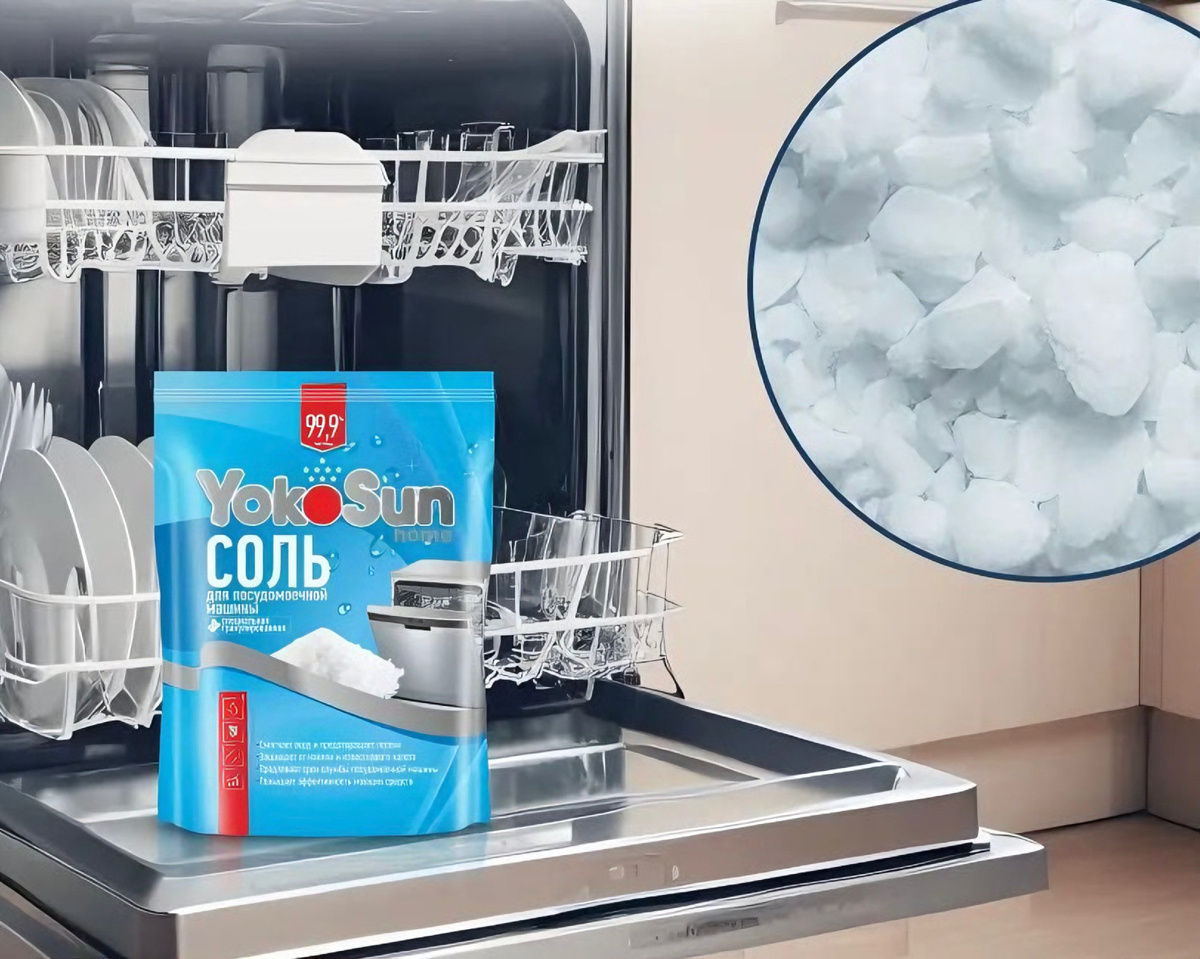
There are many myths surrounding dishwasher salt. Some people believe that it can be replaced with regular table salt, while others are convinced that such a product is nothing more than a marketing ploy. In this article, the manufacturer of household chemicals and hygiene products YokoSun will debunk the main myths about dishwasher salt.
Myth 1. Dishwasher salt is a waste of money
The most common misconception is that dishwasher salt is a completely ineffective product that simply wastes your budget. In fact, salt, in a certain sense, even saves money. For example, for repairs or purchase of new equipment or cleaning products.
Salt is needed primarily to soften water. The hardness of water is determined by the presence of minerals in it - calcium, magnesium, sodium and others. They affect the operation of the machine.
Firstly, minerals settle on the heating elements, forming scale. Over time, this can lead to failure of the mechanisms. Secondly, calcium, magnesium and other elements provoke rust. It is believed that the machine can last no more than two years if hard water is used. And thirdly, it is these minerals that settle on the dishes with an unpleasant white coating; often in this case you have to wash them again. In addition, cleaning products do not foam well in hard water.
Dishwasher salt just reduces the level of water hardness. The mechanism of operation is simple: negatively charged chlorine ions in the salt attract particles of calcium, magnesium, sodium and neutralize them. Thus, the water becomes softer.
Myth 2. It seems that the water in my house is not very hard, so salt is not needed
It is believed that the hardness of water can be felt by the skin. For example, if after washing it becomes noticeably dry, then the water is really hard. In fact, everything is a little more complicated.
Water hardness can be measured, most often they focus on degrees of hardness - °W. For example, water with a hardness in the range from 1.5 to 3 °F is considered soft; from 3 to 6 °F – moderately hard; from 6 to 9 °F – hard, and from 9 °F – very hard. Dishwasher salt should be used when the water hardness exceeds 3°F.
In most Russian regions, water is hard. However, you can find out exactly what the mineral content is in the water in your home. For example, there are special test strips, and you can also contact your local water supply with the corresponding question.
Knowing the degree of hardness, you can fine-tune your dishwasher and increase the efficiency of salt use. The fact is that sometimes the salt does not have time to dissolve in the machine. In this case, adjusting the water hardness settings can help.
Myth 3. Only cheap dishwashers need salt
Many dishwasher owners are convinced that if the equipment is expensive, it should last longer without any maintenance. However, in reality this is not the case: regardless of the cost of the equipment, the mechanism for preventing the appearance of plaque, scale and rust in cars is the same.
So, all modern machines have a special compartment with an ion-exchange resin just for softening the water. It also attracts mineral particles and neutralizes them. But over time, the substance loses its properties and ceases to cope with its purpose, even if the machine was expensive. Then the resin will need to be replaced.
Salt for dishwashers is aimed precisely at saving the equipment owner from such manipulations. It has a regenerating effect on the ion exchange resin so that it can soften water longer and better.
Myth 4. Special salt can be replaced with table salt
This is the most dangerous misconception - the use of ordinary table or ionized salt in a dishwasher is strictly prohibited. Not only will it not cope with water softening, but it can lead to equipment failure.
Special dishwasher salt has a fairly high chlorine content. For example, YokoSun dishwasher salt on 99.7% consists of sodium chloride. This is enough to neutralize calcium and magnesium ions, softening the water.
Meanwhile, even good table salt contains more impurities, while the chlorine content varies from 60 to 90%. In addition to the fact that table salt is simply ineffective, due to the size of the granules, it can ruin the machine. Fine-grained salt can become clogged in equipment components, rendering it inoperable. That is why the special salt is large, due to this it dissolves faster.
Replacing dishwasher salt with other household products, such as vinegar, is alsoprohibited. Not only are they ineffective and even dangerous for equipment, most often such products are not cheaper, and sometimes even more expensive than special products.
Myth 5. You don’t need to use salt if it’s in dishwashing tablets
Some dishwasher tablets do contain salt. Some manufacturers indicate on the packaging that such a product can save you from additional use of salt for PMM. But this is not entirely true.
Such tablets cannot fully replace salt, except when the water in your home is soft. In reality, every second Russian family uses hard water.
Although some detergents do contain salt, the content is low. Therefore, it simply cannot cope with hard or very hard water. As a result, over time, rust and scale will appear on the components of the equipment, and a white coating will still begin to settle on the dishes.